2024
Nottingham and Birmingham city councils declares bankruptcy and a total cut to arts funding; we reflect that nearly all of our work, to date, has been in preparation for these ever-deepening cuts to UK’s artistic, social and civic infrastructure. We continue to tour a performance across the homes of our friends, and spend four months hand-printing a book of demonic wisdom. For one of us thrice-yearly ‘away days’, we visit a high fashion clothing store in central London and help each other try out some bold looks.
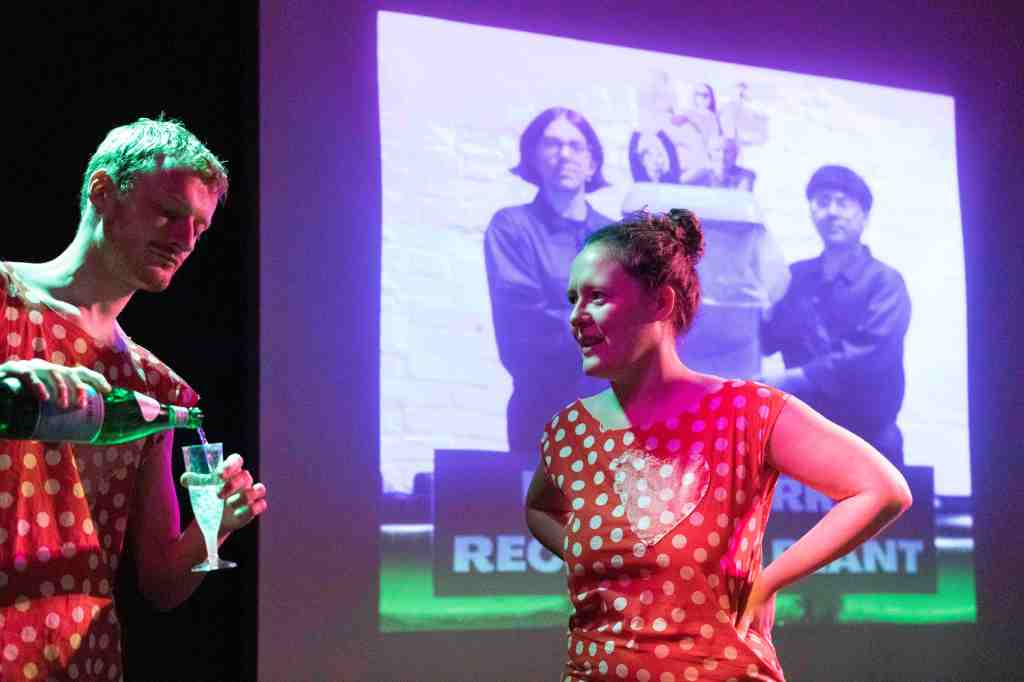
Photo by Jemima Yong
2023
Rather than change our website each year, we decide to finally commit to a permanent site that can represent our major work. We start putting together a book that will archive some of the off-cuts and detritus that will be excluded from this neat portfolio. We present a work-in-progress performance that we have been working on since 2019; someone describes it as “London’s hottest new play, but somehow achieved by these two performance art nobodies on a shoestring budget.” We put together a solo exhibition of different strands of our work (embroidery, monoprint, text, clay, video, wreath-making, collage), and then tour a unfunded performance to people’s homes in Nottingham, London and Bristol. Whenever we do any of these diverse projects, we think: “Gosh, if only we could do this, just this, forever.”
2022
We decide to make a demonology, and ask friends of ours around the world to help us write it. We take a list of titles we have collected for possible works, and use them to as a starting point for a series of paintings. As we prepare to mark 10 years of working together, we decide to ‘Marie Kondo’ our practice: compiling an e-book of all the applications we have ever written, and creating a performance which we try to give away all of our ideas we have not yet acted upon. On a sunny residency in Italy, we eat lots of ice cream, and get into an argument about how we direct and demand from each other in rehearsals.

2021
We run a choreography course by post in which we encourage people to quit the field of professional dance. We begin to obsessively track our working hours in order to meticulously calculate how we our work is institutionally remunerated. We make a performance for the office spaces in arts organisations, full of head-banging and techno and disco-lights. We grow increasingly entranced with a linoprint series of angry little faces; at first we call them ‘friends’, later we call them ‘demons‘.
2020
The pandemic hits. We finish our video series that exhaustively explains the relationship between ‘Practice’ and ‘Theory’ to kids; and write Ghosting.zip, a digital zine about haunting/haunted institutional spaces. We decide to commit to maintaining a material studio practice and award ourselves a series of ‘home residencies’. We start a PhD at Sadlers Wells Theatre.
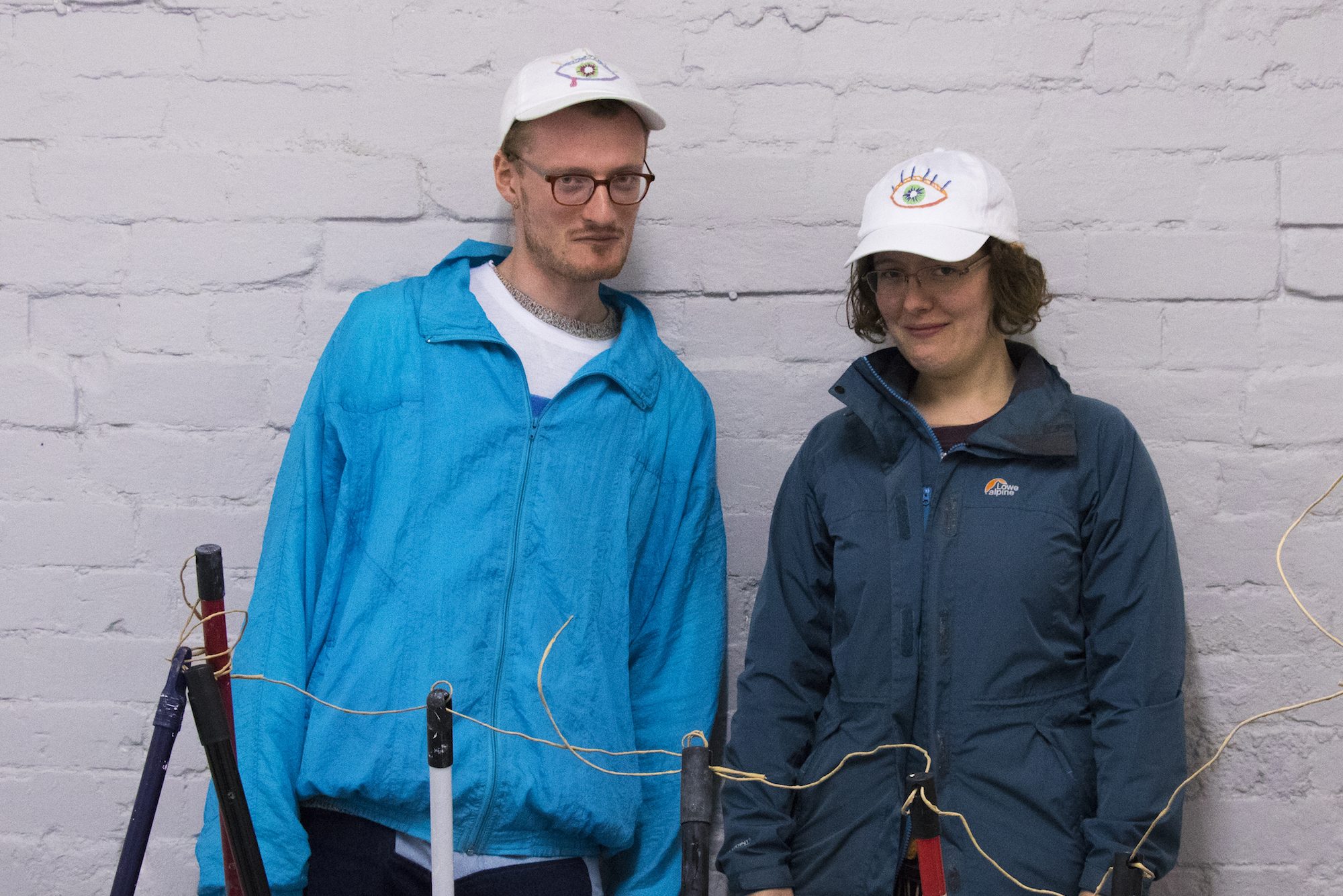
Photo by Adam Grainger
2019
We start to have quarterly ‘away days’, in which we write 18-month plans and have vulnerable conversations about our relationship. We have a nice time on residency at a big dance house in Germany. They lend us bicycles and it’s very sunny. We run a two day workshop in which people dress up as ghosts and haunt an arts organisation. It breaks our hearts. We go straight to a dance festival in which we have been invited to perform: it becomes a furious battle with the international cohort of delegates, programmers and curators. To combat this marketisation of the festival, and make a bridge to the local visual arts scene, we mount on a solo exhibition with a local artist-led gallery. Nobody from the festival attends.
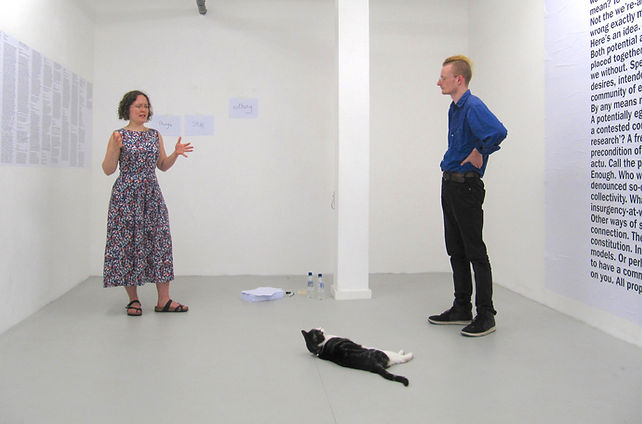
Photo by Edward Dorrian
2018
We organise a night of performance to present out new performance This at a corporate-feeling space in East London. The evening is lit beautifully by the sunset and a friend described it ‘like nothing else in London’. We celebrate our fifth year of working together. We invite lots of friends and collaborators around to celebrate two of our zines and eat some food. We look around the room – it is full of weirdos, loners, misfits – and think “these are our people.”
2017
We organise an evening to perform our work Some Possibilities. Tired of administration, and pessimistic about our ability to spread the word, we spend an afternoon filming Rohanne drop a series of objects and call it It’s Out of Our Hands. People tell us they love it. We set up an independent radio station called Radio Play and invite our friends to send in material. On the first broadcast we recite John Cage’s Lecture on Nothing.
2016
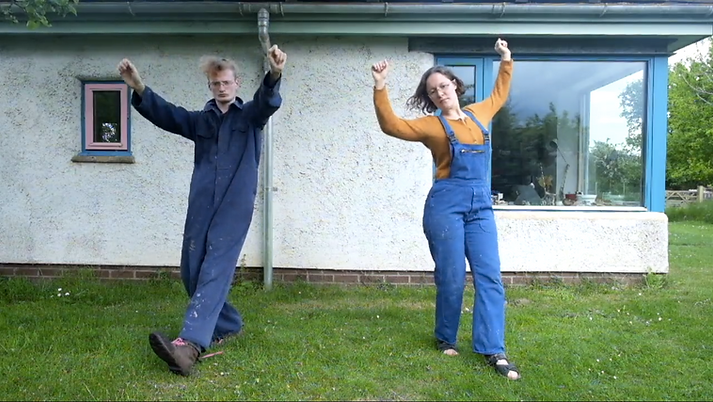
We make our first good performance, Empty Gestures, in which we learn and synchronously perform a long series of hand gestures we find on the internet. A friend rushes up to us after our first performance, aghast, to tell us that we each perform the work in an entirely different quality. We decide that we don’t mind.
2015
A drunk theatre producer in a bar offers us our first residency: a week in a theatre in Ipswich. It’s the first time we’re working together without having anything in particular we need to make. We end up making a series of short videos we call Meaningless Dances. We also make a video work called Open/Close: when we screen it, two men argue with each other about whether or not we are a couple.

2014
We write, print and circulate a programme for a fake venue at the Edinburgh Fringe. Across the year, we work at distance from one another on a series of text pieces called Attend – a collection of ambiguous prompts for audiences and readers – which we present at cabarets, mix-bill evenings and group exhibitions in Edinburgh and London.
2013
We join a group of art students to take over of a former JobCenterPlus. We make Office Simulation Space – our first piece with just the two of us – in which we busy ourselves in a small room only visible through a window with Venetian blinds. We ask all the other performers in the evening to occasionally to take a break, and join us in gathering around a full kettle of water and silently watching it boil.
 Salamèche